Interceptive orthodontics is a treatment carried out between the ages of 5 and 9 to help the mouth grow with enough room for the permanent teeth. It doesn't move teeth: it guides growth. That's why it is shorter and simpler than braces, and 3 out of 4 children who have it at the right time don't need them afterwards.
What Is Interceptive Orthodontics
As your child grows, so does their mouth. Interceptive orthodontics makes the most of that moment to widen the palate and make room for the teeth that are still to come. At wiloo we call it growth guidance, because that is exactly what we do: help the mouth grow healthy and with enough space.
The idea is simple. If at the age of 6 it is already clear that the new teeth won't fit, it is much easier to make room for them now than to wait for them to come through crooked and straighten them later.
Interceptive orthodontics and braces: how they differ
They are two different treatments, for two different moments.
| Interceptive orthodontics | Braces or aligners | |
|---|---|---|
| When | From 5 to 9, while the baby teeth are being replaced | Once the permanent teeth have come through, at around 12 |
| What it does | Guides growth and creates space | Moves the teeth to align them |
| What it looks like | A fixed system worn on the inside, which can't be seen when smiling | Braces or clear aligners |
| How long it takes | Between 12 and 18 months | Between 12 and 24 months |
One does not replace the other: interceptive treatment prepares the ground. And once the space is there, whatever comes next is shorter and easier.
If your child is older, find out how we approach orthodontics for teenagers.
Signs that your child may need it
These are things many parents notice at home without realising there is a solution:
- The baby teeth are very close together, with no gaps between them.
- A permanent tooth comes through behind the baby tooth.
- When biting, the upper back teeth sit inside the lower ones (crossbite).
- The front teeth don't meet when the mouth is closed (open bite).
- Thumb sucking beyond the age of 3 or 4.
- Breathing through the mouth or sleeping with the mouth open.
If you recognise any of them, there is no need to wait. At the age of 5 we carry out the first growth guidance check-up and tell you whether it is best to act or simply keep an eye on it.
You can also read when to start children's orthodontics.
When we treat and when we wait
Not every child needs it, and it doesn't always have to start straight away.
- We treat straight away when there is a crossbite, a significant lack of space or a very marked habit, even if all the teeth are still baby teeth.
- We treat at around 6 to 8 when the first permanent teeth have come through and it is clear that space is short.
- We wait and monitor when the issue is mild: we check it and assess it again later.
What treatment is like at wiloo
We have been devoted to children's dental health for more than 40 years, and we have designed it so that you and your child can carry on with normal life.
- First visit. We check whether there is room for the new teeth and how the bite fits together, and show you on screen.
- Digital scan. We take the measurements with a scanner, like a video of their mouth. No putty and no moulds.
- Fitting. We fit a made-to-measure fixed system that sits on the inside and can't be seen when smiling. We start with the upper arch and add the lower one about 4 months later.
- Check-ups. We see you roughly every 2 months.
- Follow-up. Afterwards, we check every 6 months how the permanent teeth are coming through, until about the age of 12.
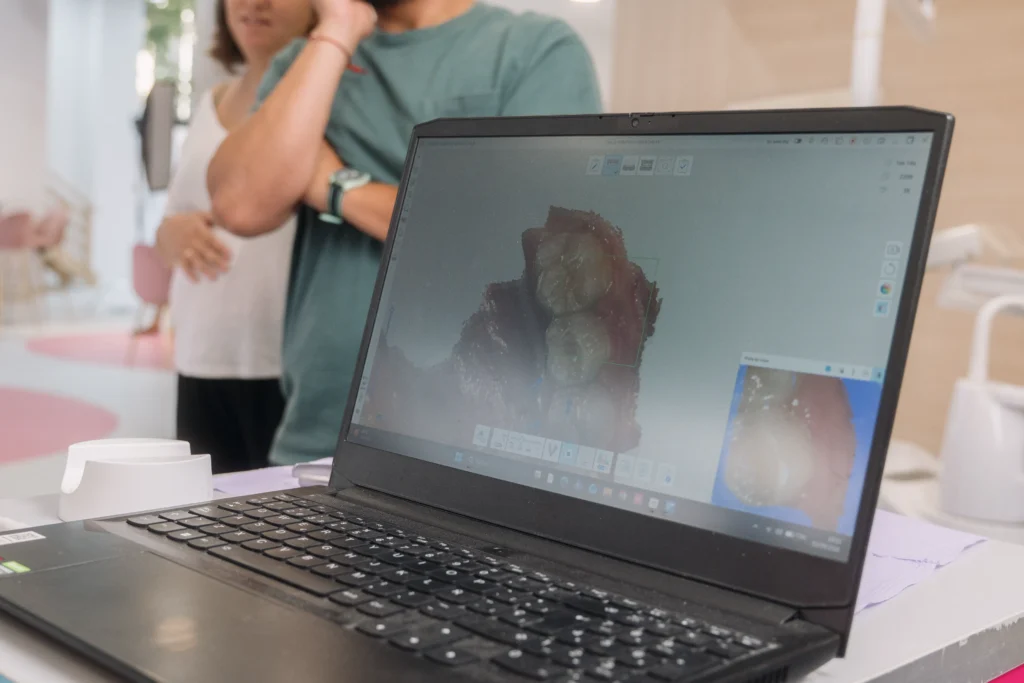
The full treatment takes between 12 and 18 months. You will find all the details on our page about children's orthodontics.
Will they need braces later?
It is the question we are asked most often. 3 out of 4 children we treat at the right time do not need braces afterwards.
And when they are needed, it is a short second phase of around a year, because the space is already there.
Why it is better not to wait until 12
Many families come at that age “to get braces”. It can be done, and the result is good. But the moment for guiding growth has passed, and all that is left is moving teeth: treatment takes longer and, sometimes, a tooth has to be removed to make room.
Starting at the right time is what makes it simple. If your child is losing their baby teeth, see when baby teeth fall out and in what order.
Frequently Asked Questions
Isn't 5 too young?
No. It is precisely the age at which the most can be done, because the mouth is growing. And if it isn't time yet, we keep an eye on it and let you know when it is.
Does interceptive orthodontics hurt?
It doesn't hurt. The first 2 or 3 days are a period of adjustment and some sounds may be harder to pronounce. After that, life goes on as normal.
Do we have to do anything at home?
Generally, nothing: it is fixed. Just take care with brushing and avoid hard or sticky foods. In some cases we ask for a small adjustment every night for the first 30 days.
How much does interceptive orthodontics cost?
It depends on what your child needs, and we see that at the first visit. We give you a fixed quote, with no small print and the option to pay in instalments, covering the treatment, every visit and the follow-up checks.
Come in and we'll take a look together
If you have noticed any of these signs in your child, book an appointment and we will tell you whether it is the right time. Come and meet us at our centres in Terrassa, Girona, Torrent and Vic. The first visit is free.